
What is kañiwa? Simply put, this relative of quinoa, is similarly a South American superfood grain making a splash in the North American market. Like quinoa, Kañiwa grows in Peru and Bolivia. It's an excellent source of protein and amino acids, is exceptionally high in iron, and is gluten-free. Dark reddish-brown in color and about half the size of a tiny quinoa seed, it cooks up quickly to resemble a smaller version of red quinoa. Find out lots more information in Kañiwa: A "New" Ancient Superfood.
One major difference between the two is that kañiwa doesn't have saponins, the coating that gives quinoa a soapy, slightly bitter flavor if not rinsed properly. A good thing, as I can't imagine a sieve fine enough for its tiny size.
Quinoa brought to market has already been rinsed of much of its saponins, as otherwise it would be quite unpalatable (this procedure is done with a strong alkaline solution). But it's always recommended that quinoa be rinsed well again at home to remove any remaining bitterness. Kañiwa is actually easier to process due to the absence of saponins.
It's recommended to toast the grain on a dry skillet or saucepan first, then cover with water in twice its volume. Like quinoa, the water absorbs in 15 to 20 minutes. Truth be told, both times I used it so far I forgot to toast it, and it was just fine (it has a mild, nutty flavor similar to quinoa's).
A few simple ways to use kañiwa
- Add ½ to 1 cup cooked kañiwa to pancake or waffle batter (depending on the size of the batch)
- Serve it as a sweet breakfast bowl with a maple syrup to taste, chopped nuts, and dried or fresh fruit. Finish with a dusting of cinnamon.
- A savory breakfast bowl is good too, with a little vegan butter and a sprinkling of nondairy cheese shreds. Sweet or savory, a it keeps you full for hours.
- Like many a nutritious grain, kañiwa works well in warm pilafs and room-temperature salads.
- Come fall holiday meals, like its slightly larger cousin, a pilaf makes a nourishing and attractive stuffing for squashes and peppers.
Nutritionally, kañiwa's profile is remarkably similar to quinoa's. It's a good source of complete protein, and is a good source of a wide range of vitamins and minerals. One advantage it has over quinoa is that it's an even better source of iron.
How to cook kañiwa
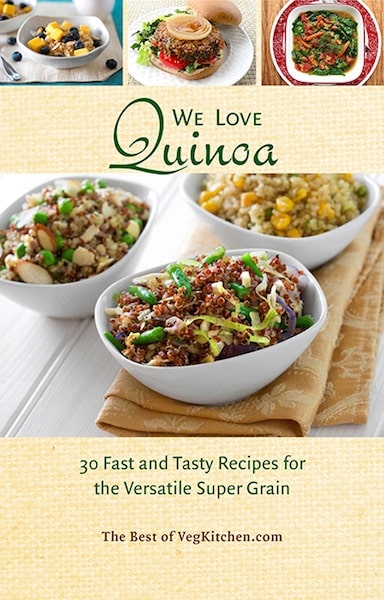
Kañiwa and quinoa can be used interchangeably, and are cooked in the same proportion to liquid (2 parts liquid to 1 part kañiwa; it cooks in 15 minutes, like quinoa, or just a bit quicker). To that end, please explore our article, How to Cook Quinoa - and Some Great Ways to Use It. You might also enjoy We Love Quinoa, a volume in our Best of VegKitchen affordable e-book series featuring the 30 most popular quinoa recipes on this site, along with many color photographs.
Kañiwa is available from online retailers, you can ask your natural foods retailer if they can order some for you.
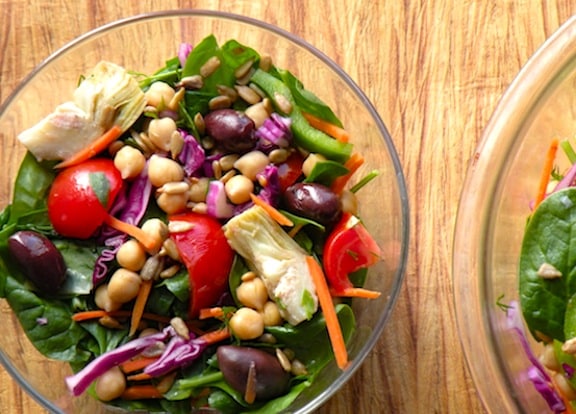
For a recipes, see Kañiwa Confetti Salad (shown at top).
- For lots more features on healthy lifestyle, explore VegKitchen's Healthy Vegan Kitchen page.
- Here are more of VegKitchen's Natural Food Guides.
*This post contains affiliate links. If the product is purchased by linking through this review, VegKitchen receives a modest commission, which helps maintain our site and helps it to continue growing!


suz says
Thanks for the info, much appreciated!
Cindy Brougham says
I love kaniwa. How long does kaniwa "keep" after cooking and refrigerated?
Cindy Brougham says
How long can I keep kaniwa after cooking and refrigerating it?
Nava says
Cindy, I would say that it keeps in a tightly lidded container for 3 to 4 days. My guess is that it would freeze well, too, in an airtight container, for a couple of months.
Kathy says
Does kaniwa have to always be cooked? Can it just be soaked and eaten or added to others dishes or ground and used as flour?
Thank you.
Nava says
Kathy, sorry for the delayed response. Yours are good questions, but I don't have the answers. If you find out, can you come back and share the information? It would be greatly appreciated.
Theresa Maria Braun says
Is there a cookbook just on Kaniwa?
Nava says
Theresa, not that I'm aware of. But you can use kaniwa interchangeably with quinoa in recipes. So you can consult any quinoa cookbook or individual recipes on the web.
martha says
I found the best way to rinse quinoa was to use one of the gold coffee filters. There is no rim for the grains to get stuck under and the mesh is fine enough that the grains don't slip thorough. Also, it's easy to get almost all the grains out and not wasting any.
Nava says
That's an excellent suggestion, Martha. Sometimes I get lazy about rinsing quinoa, though I know it needs to be done. Fortunately, Kaniwa doesn't need to be rinsed, and that's good considering how tiny it is.
shashi says
Can anyone let me know from where to by Kaniwa that is mud free and dirt free at a reasonable price? Please email me? Thank you! [email protected]
Sherisa says
Shashi - I get mine from nuts.com
Plato says
Kaniwa, amaranth, brown rice, quinoa, wild rice, white rice, bulghar, wheat berries, I use them interchangeably in these salad like recipes of the west...I mean west of america.My love is for my native cuisine, & we do have innumerable local recipes for all these except quinoa, which does ot grow in India because it is not native to India. I believe all the exponential rise in allergies & a lot of other "idiopathic" 7 "auto-immune" diseases with no explanations, are possibly the result of people leaving their local foods for those grown across the globe from them. The doctors & the politicians will not agree. But if any one takes time to look at the time line, the correlation & causation will be quite clear.
Roman says
@Plato -- Thanks for solving this mystery. I was wondering what the cause of all the allergies and autoimmune disease was and now I know.
Norman Privay says
@Plato, that is a great point regarding alien foods potentially being linked with allergies and autoimmune disease. It would be interesting to examine this further. Most statisticians, however, would caution against the logic that correlation implies causation. Do you know of some good data sets?
Sharon says
I live in Atlanta. I found Kaniwa, in bulk, at my local Sprouts Market.
tom Hamilton says
Sprouts market has it on sale for half off at 2.99
Elena says
Does anyone know where to get a strainer for kaniwa. The grain is very small and I like to soak my grains. Thank you
Nava says
Elena, sorry for the delayed reply — I don't know specifically of a strainer with holes smaller than in the standard kind, but I wonder if, once you soak them, they'd swell enough not to go through the holes. Otherwise, there's also the idea of lining a regular strainer with a couple of layers of cheesecloth.
jesse says
.99 a pound at sprouts houston sale
Beverly Johnson says
$.99/pound @ Sprouts in Tucson too, though it is a special sale of $5.00 off.
Andre Bordes says
Kaniwa is on sale at sprouts for 99cents the pound
Abigail says
Yesterday feb 2 , kaniwa price $0.99 cents per pound in Sprouts Mckinney Tx but was at 6.00 regularly
Sharon says
The best for rinsing would probably be a mesh strainer.But even then it would need to soak an enlarge a bit. Or line with a paper towel which might be easier to disengage the seeds from than cheese. But the article indicates it doesn't need to be rinsed.
Nava says
Sharon, common wisdom says that kañiwa doesn't need to be rinsed, because unlike quinoa it doesn't have the bitter saponins. Thanks for your input, though, for people who want to give it a rinse in any case.
Rebecca Rhaesa says
Use a coffee filter if you want to rinse it. Worked well.
Lisa Burris says
Sprouts has it on sale for 99 cents a pound right now.
Bonnie Yachimec says
I got some kañiwa from the bulk food store up here and it CAN be ground for flour according to the fact sheet provided with it. It also DOES NOT have to be rinsed.
Sistah Modupe says
Sprouts no longer carrying it in bulk in Los Angeles area.
Monique Benun says
Thank you for the comprehensive info.
I have two packages of Kaniwa in my house, avoiding cooking because I didn't want to go through the nightmare of rinsing. So much was wasted the first time I made it!
My vegan son will be happily surprised when I serve the unrinsed kaniwa.