
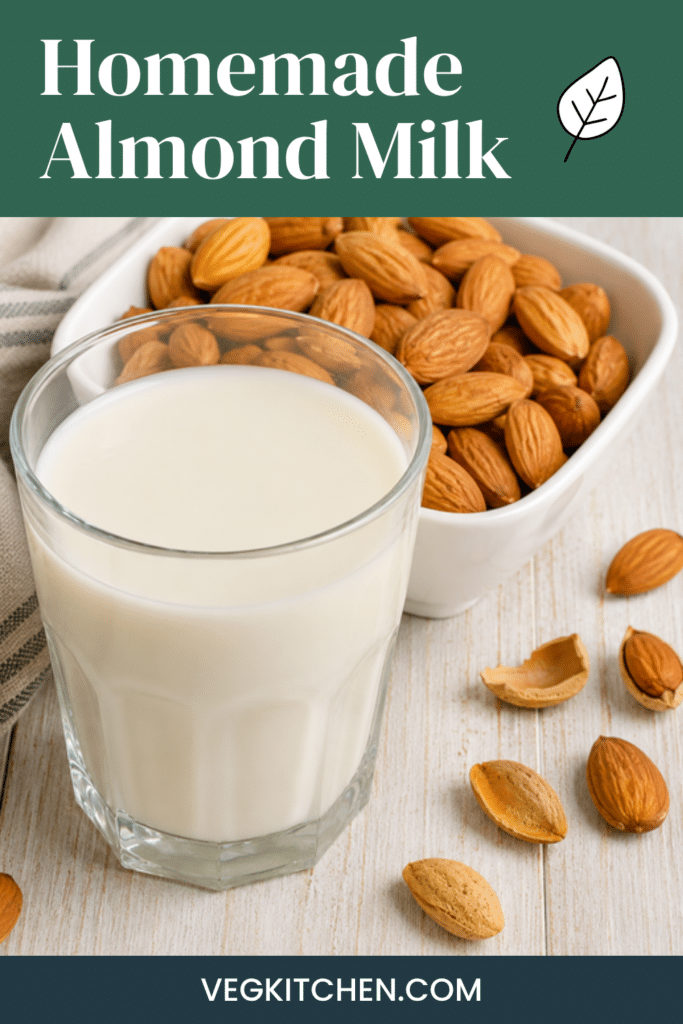
This homemade almond milk is richer and more nutritious than boxed nondairy milk, and it comes together in just minutes with a blender and a strainer. Once you taste the difference, it's hard to go back to the boxed stuff, and you control exactly what goes into it — no gums, stabilizers, or added oils, just almonds, water, and whatever sweetness you choose to add.
Recipe adapted from Raw Food Made Easy for 1 or 2 People by Jennifer Cornbleet, reprinted by permission of The Book Publishing Company.
Key Ingredients & Substitutions
- Raw almonds. Look for raw, unsalted almonds — roasted or salted almonds will throw off both the flavor and the soaking process, and can leave the milk tasting oddly savory.
- Soaked almonds. Soaking softens the almonds so they blend into a smooth, creamy milk instead of a gritty one — don't skip this step, even though it adds time upfront.
- Medjool dates. These add natural sweetness and body. Regular dates work too, just soak them a little longer since they're firmer and won't blend as smoothly straight from the package.
- Vanilla extract. Optional, but it rounds out the flavor nicely. Leave it out for a neutral milk to use in savory recipes like soups or sauces.
- Filtered water. The ratio of water to almonds determines how rich or light the milk turns out — adjust to taste, using less water for a creamier, more concentrated milk.
Variations
- Make it chocolate. Blend in a tablespoon of cocoa powder for chocolate almond milk, sweetened to taste.
- Add spice. A pinch of cinnamon or a dash of salt brightens the flavor and makes it taste more finished.
- Skip the dates. For an unsweetened version, simply omit the dates — useful for coffee or savory cooking.
- Try other nuts. This same method works well with cashews or a mix of almonds and cashews, which blend even more smoothly since cashews don't need straining.
- Add a banana. Half a ripe banana blended in makes the milk noticeably creamier without tasting overtly like banana.
- Make it a smoothie base. Skip straining and blend the whole mixture with fruit for a fiber-rich smoothie instead of a strained milk.
Tips for the Best Almond Milk
- Soak the almonds fully. A full 8 to 12 hours softens them enough for a smooth blend — don't rush this step, and plan ahead by soaking them the night before.
- Remove the skins for extra creaminess. It takes a few extra minutes, but skinned almonds make a noticeably smoother milk with less grit — the skins slip off easily after soaking.
- Strain thoroughly. Press the pulp well with a spatula, or use a nut milk bag, to extract as much milk as possible — a nut milk bag gives the cleanest, smoothest result.
- Shake before using. Homemade almond milk separates in the fridge since it has no stabilizers — just give it a good shake before pouring.
- Use the leftover pulp. Save it for baking, smoothies, or homemade granola instead of tossing it — it's still full of fiber and nutrients and can be dried in a low oven for almond flour.
Make Ahead & Storage
This almond milk keeps in the refrigerator for about 5 days in a sealed container. It will separate as it sits since it has no stabilizers or emulsifiers, so a good shake before each use brings it back together. It doesn't freeze particularly well, since the texture changes once thawed, so plan to make only what you'll use within the week.
How to Serve
Enjoy this almond milk cold over cereal, stirred into coffee or tea, or blended into smoothies.
Recipe
Homemade Almond Milk
Ingredients
- 1 ½ cups soaked almonds see note
- 2 ½ cups water divided
- 3 pitted medjool dates soaked
- ½ teaspoon vanilla extract optional
Instructions
- Place 1 ½ cups of the water and the almonds, dates, and optional vanilla in a blender. Blend on high speed until very smooth. Add the remaining 1 cup of water and blend until smooth.
- Place a fine-mesh strainer over a medium bowl and pour the almond mixture through it. Using a rubber spatula, stir and press the pulp caught in the strainer to extract as much milk as possible. Alternatively, use a nut milk bag to strain.
- Discard the pulp left in the strainer, or save it for another purpose.
- Transfer the almond milk to a sealed container and refrigerate. It will keep for about 5 days and will separate as it sits, so shake well before using.


Jan says
Thanks to this recipe, I am on my third batch of home-made almond milk. I have been experimenting: I've added 1/4 teaspoon of almond extract, reducing the vanilla extract to 1/4 teaspoon, and added a dash of cinnamon and salt. Next time I want to add a dash of my pumpkin pie spice mixture.
But I have a question. Does the soaking liquid have to be discarded, like soaking bean water, or can it be used as part of the liquid placed in the blender?
Thank you, Jan
Thank you, Jan
Jan says
Thanks to this recipe, I am on my third batch of home-made almond milk. I have been experimenting: I've added 1/4 teaspoon of almond extract, reducing the vanilla extract to 1/4 teaspoon, and added a dash of cinnamon and salt. Next time I want to add a dash of my pumpkin pie spice mixture.
But I have a question. Does the soaking liquid have to be discarded, like soaking bean water, or can it be used as part of the liquid placed in the blender?
Thank you, Jan
Jan says
The last few weeks I have been making almond milk almost every other day and I have learned a thing or two I'd like to share with you all. (1) The milk is creamier if you take off and discard the almond skins before blending. This is a little time consuming, it takes about ten minutes, but so worth it. (2) I now add 1/2 a banana, the texture is so much more richer but there is no profound banana taste. (3) a dash of salt really brighten the milk up.